Learning Experience Designer
hello, i'm Rosemarie.
I design and develop engaging, accessible, and performance-focused learning experiences that help people apply what they learn with confidence.

I design and develop engaging, accessible, and performance-focused learning experiences that help people apply what they learn with confidence.
About Me
I'm Rosemarie Canturia, an educator transitioning into Learning Experience Design after more than 10 years of experience in local and international learning environments. This transition is an intentional extension of the work I have always enjoyed: understanding learners, simplifying complex information, designing meaningful activities, and helping people apply what they learn with confidence.
Throughout my career, I have supported individuals with different backgrounds, abilities, and levels of understanding. These experiences strengthened my skills in identifying learning needs, organizing content, writing clear instructions, developing assessments, and adjusting learning strategies based on feedback. They also taught me that effective learning is not simply about presenting information — it is about creating relevant experiences that support better decisions and improved performance.
As part of my transition, I have developed branching scenarios, gamified activities, responsive microlearning courses, assessments, and AI-assisted training videos. I use Articulate Storyline 360 to create customized interactions with variables, triggers, states, layers, and conditional feedback. I also use Rise 360 to build structured, responsive courses and Synthesia to produce engaging video-based learning content.
My approach is guided by adult learning principles, scenario-based learning, gamification, Universal Design for Learning, and performance-focused instructional design. I am committed to creating inclusive experiences by considering WCAG 2.1 accessibility standards, including readable text, sufficient color contrast, keyboard navigation, logical focus order, alternative text, and screen-reader support.
To strengthen my knowledge and technical skills, I completed a Learning Experience Design course offered by the University of Michigan through Coursera and Articulate Storyline training offered by PACT through Coursera.
I am passionate about transforming complex workplace challenges into practical, engaging, and learner-centered solutions. My goal is to create learning experiences that are visually purposeful, accessible, and closely connected to the knowledge, decisions, and behaviors learners need in real-world situations.
Instructional Design
Authoring Tools
Design & Planning
Specializations
Featured Project
A scenario-based eLearning experience designed to reduce preventable hospital readmissions by equipping care coordinators to recognize worsening symptoms, apply teach-back communication, and resolve patient follow-up barriers.

Coordinators complete training at their own pace without interrupting patient care responsibilities.
Uniform guidance on symptoms, teach-back technique, and follow-up barrier resolution across all staff.
Assignable to both new hires and experienced coordinators through the LMS with automated reminders.
Learners practice clinical decisions without endangering a real patient, with immediate consequence feedback.
My Process
Because this was a self-directed portfolio project, I created a fictional healthcare organization, Silver Oak Medical Center, and a fictional patient, Mary Thompson. I conducted secondary research on CHF readmission risks, post-discharge care, early warning signs, teach-back communication, and transportation-related barriers to follow-up care.
The research helped me define care coordinators as the target audience and identify three performance gaps: recognizing worsening CHF symptoms, explaining home-care instructions in plain language, and resolving transportation barriers. Based on these findings, I established the fictional organizational goal of reducing preventable CHF readmissions by 15% within six months and used it to guide the course objectives and scenario design.
Using Cathy Moore's Action Mapping approach in MindMeister, I began with the measurable business goal: reduce 30-day hospital readmissions by 15% within six months. I then identified three critical actions care coordinators must perform — recognize worsening CHF symptoms, use the teach-back communication technique, and connect patients with social and logistical support.
Each action was broken into observable behaviors, such as screening for warning signs, explaining instructions in plain language, verifying patient understanding, and arranging reliable transportation. These behaviors became the foundation of the three decision-based scenarios, ensuring the course focused on realistic practice and performance rather than unnecessary information transfer.
Action Map — MindMeister

Once the action map was complete, I organized the flow of the eLearning experience through a text-based storyboard. This step established the structure of the course by documenting on-screen text, character dialogue, visual directions, learner interactions, branching pathways, and programming notes for each slide.
I developed the story around Mary Thompson, a fictional patient recently discharged after receiving treatment for CHF. The learner assumes the role of a care coordinator responsible for helping Mary remain stable and avoid readmission. I also introduced Susan Carter, an experienced senior nurse who serves as an optional mentor providing guidance without giving away the answer.
Text-Based Storyboard Samples


I created the visual mockups in Canva, selecting deep navy and teal to communicate trust, professionalism, and calm — qualities appropriate for a healthcare setting. Warm cream softens the interface and improves readability, while orange highlights hover states and important interactions.
I tested color combinations for WCAG contrast compliance before documenting them in a visual style guide. I developed wireframes for the character-selection, dialogue, and three-option decision screens — then built high-fidelity mockups with consistent character placement and button states.
Visual Design & Wireframes


After finalizing the storyboard and visual mockups, I developed the interactive prototype in Articulate Storyline 360. The prototype includes the course introduction, character selection and name-entry interactions, an orientation by mentor Susan Carter, and the telehealth scenario with Mary Thompson.
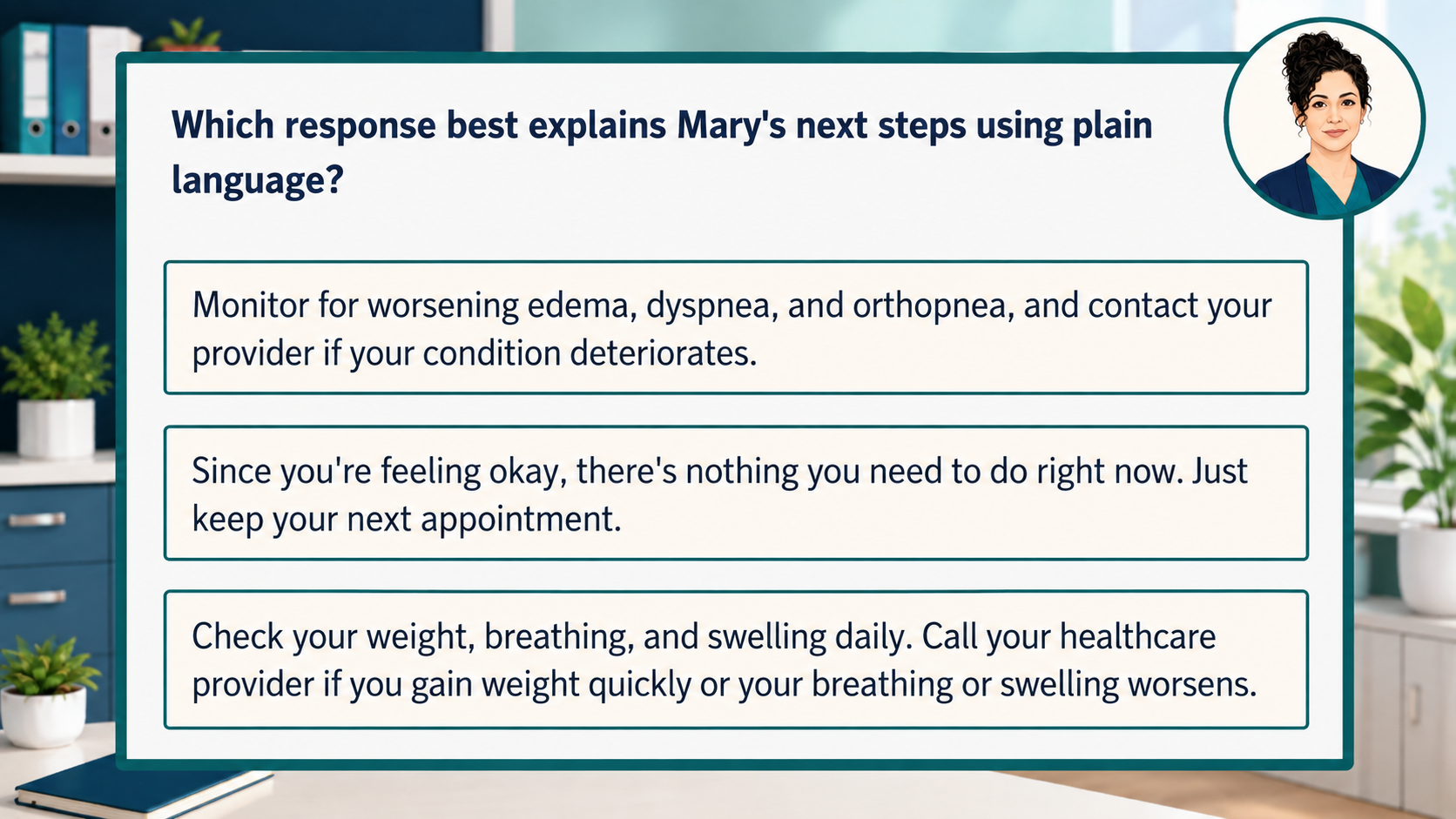
The scenario presents three critical decision points aligned with the action map. Learners select from realistic response options and receive immediate, consequence-based feedback. A health meter driven by a Storyline variable updates after each decision. I used variables, triggers, object states, and slide layers to create a personalized, responsive experience throughout.
Prototype Screens
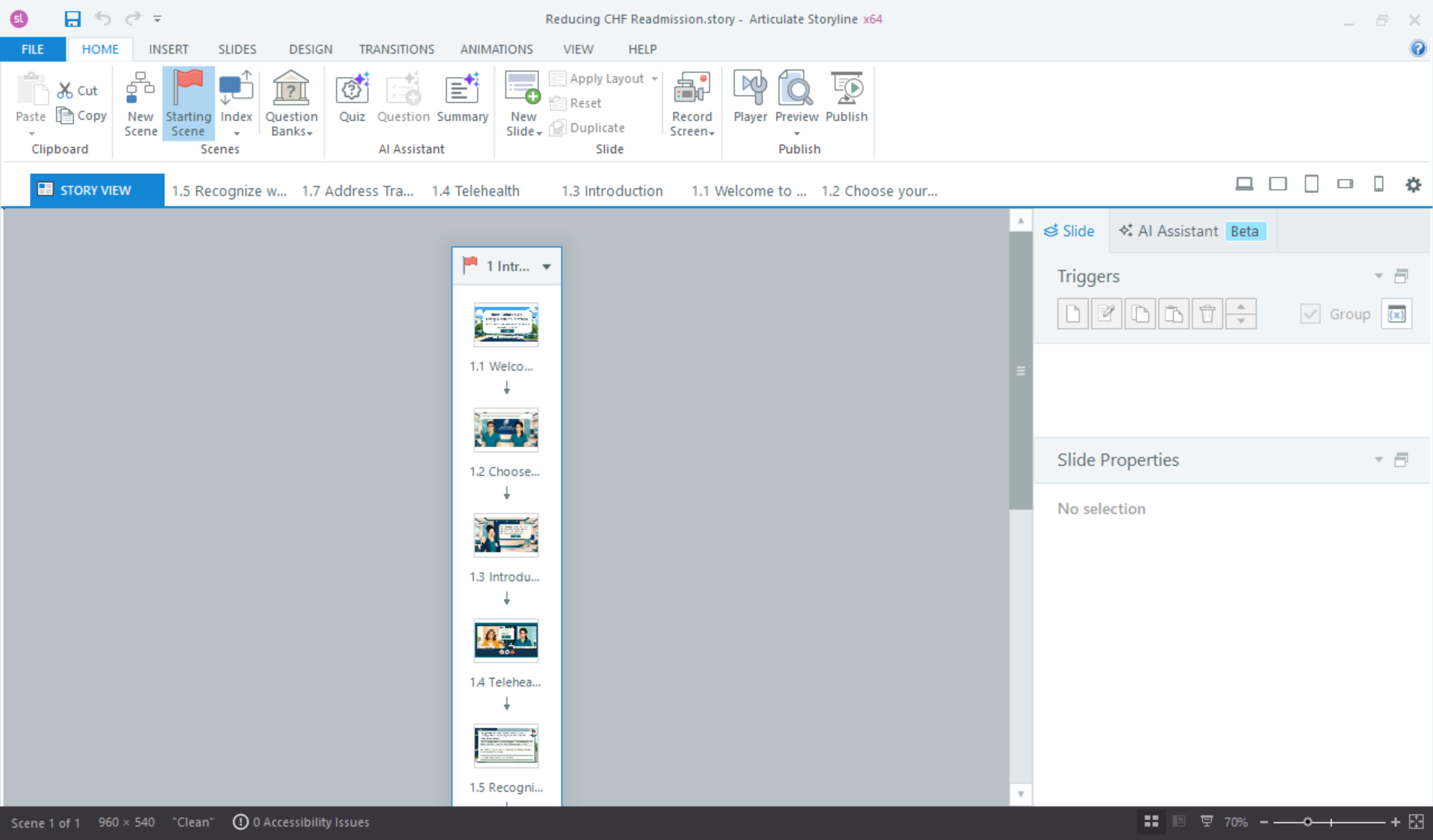
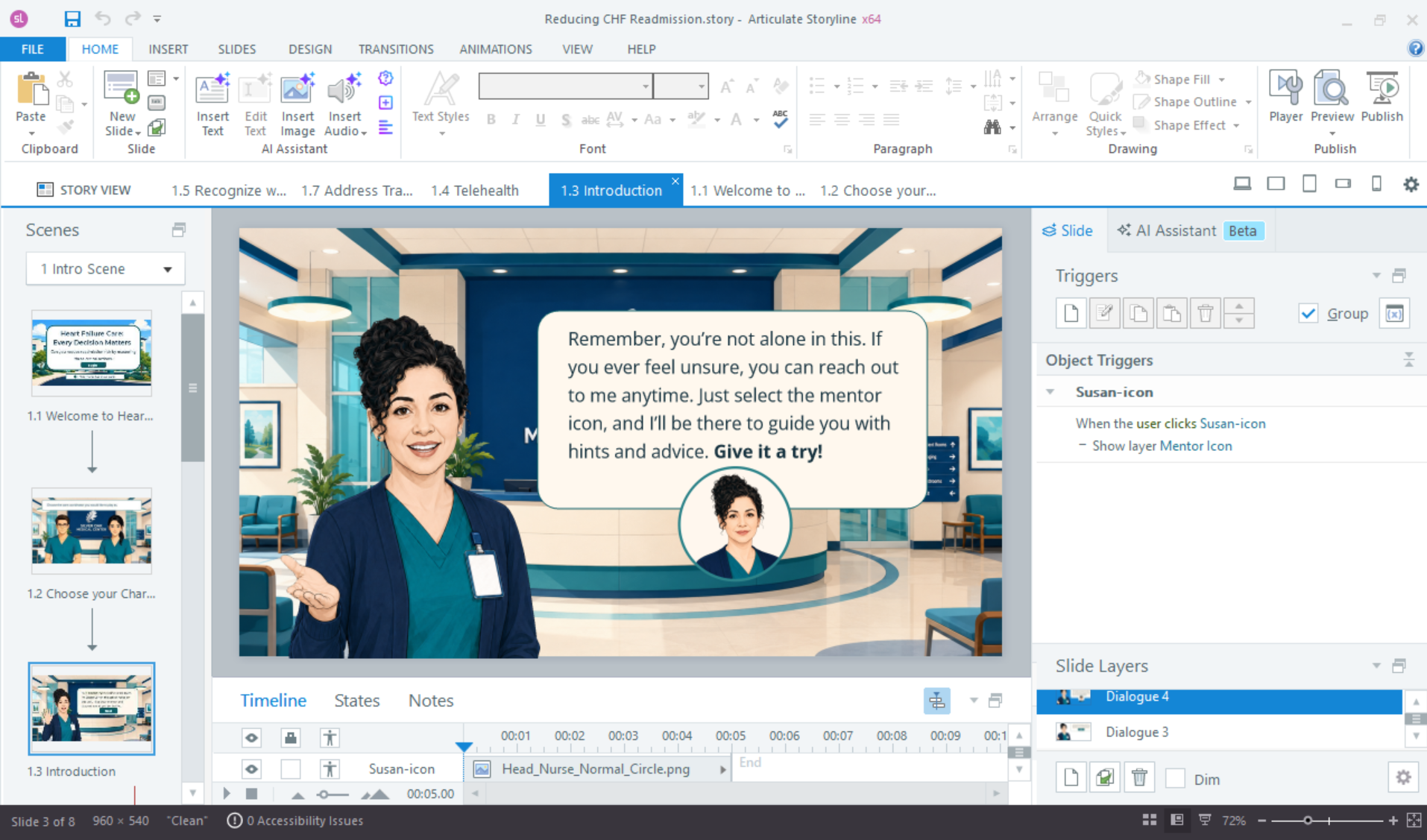
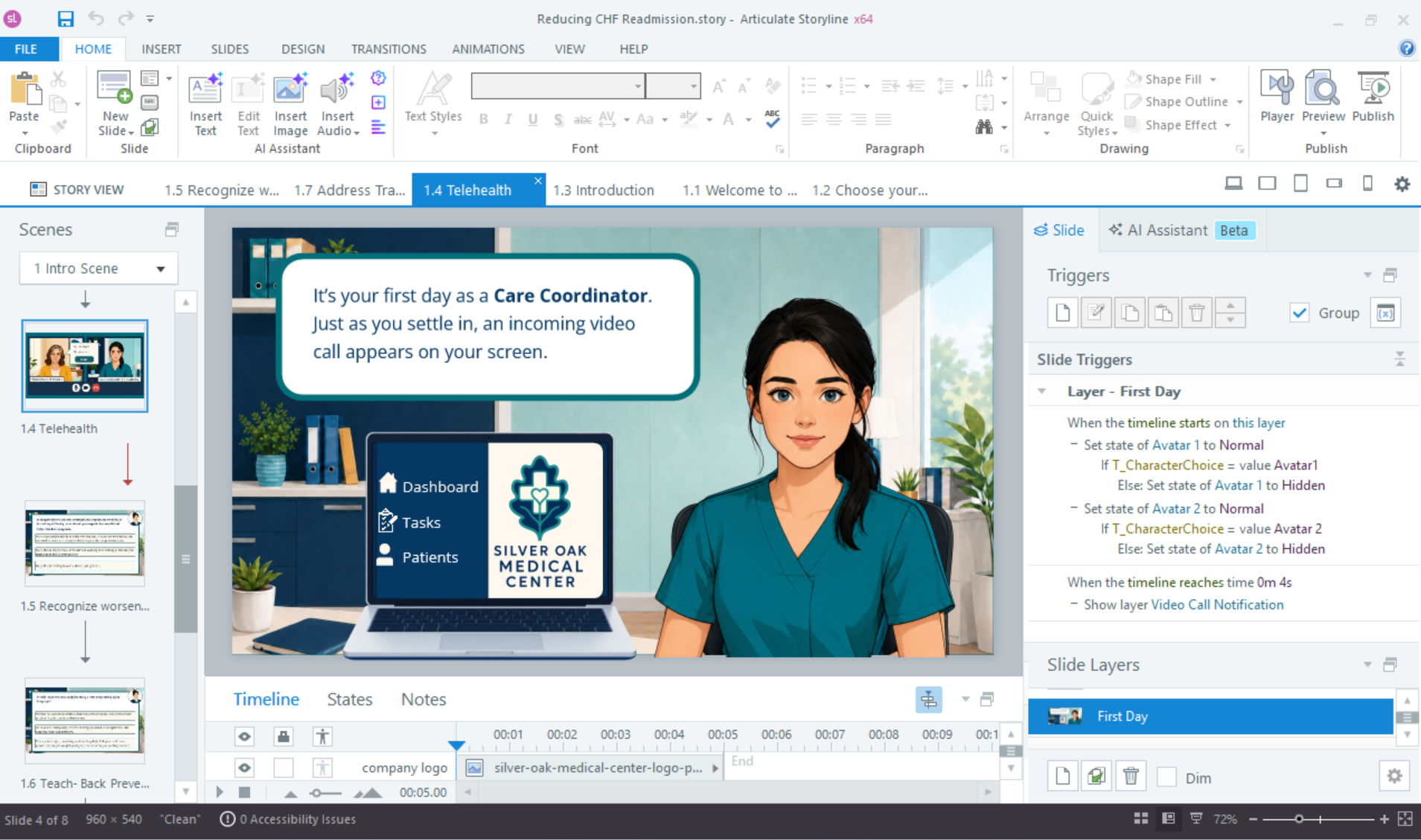
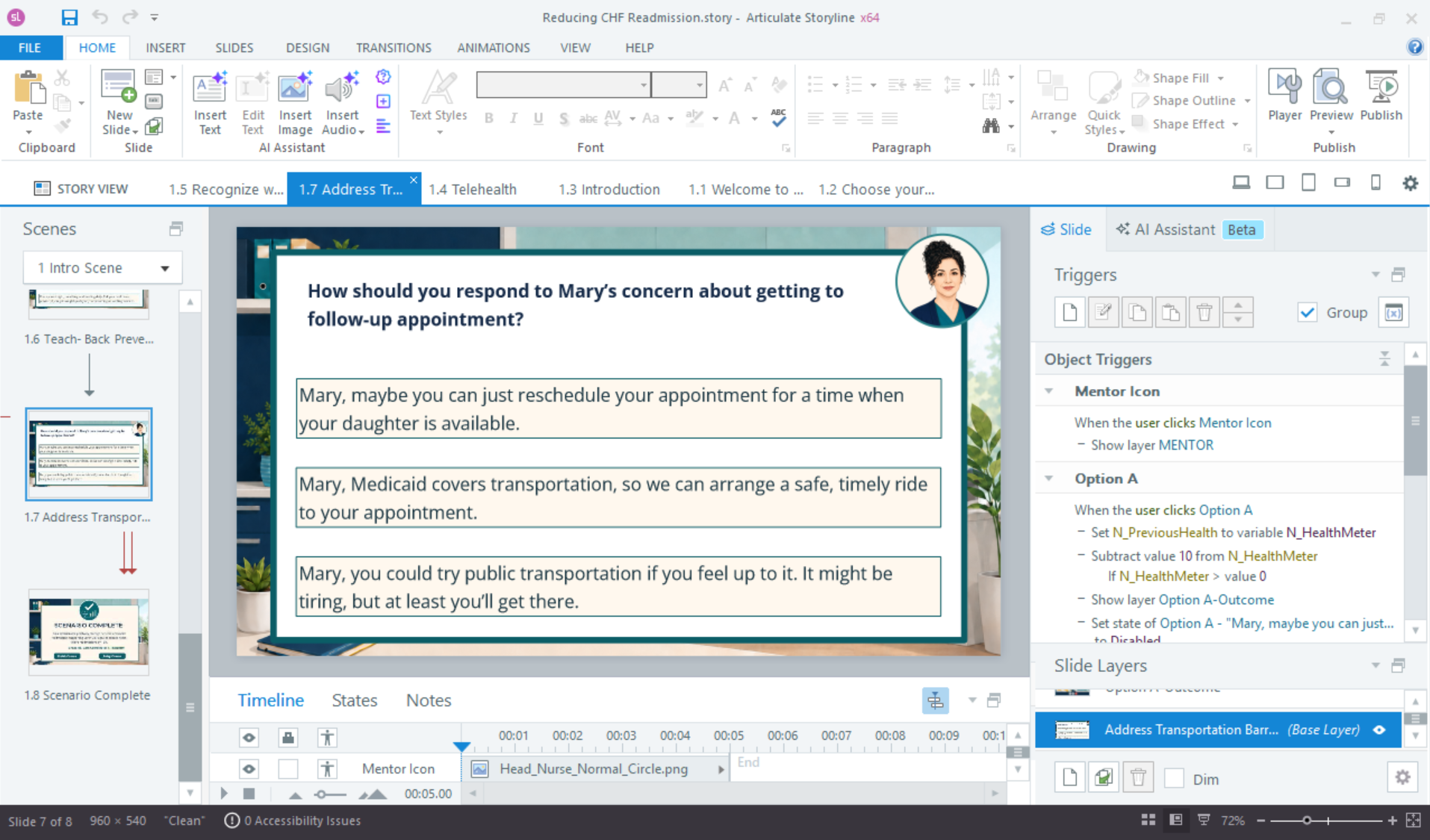
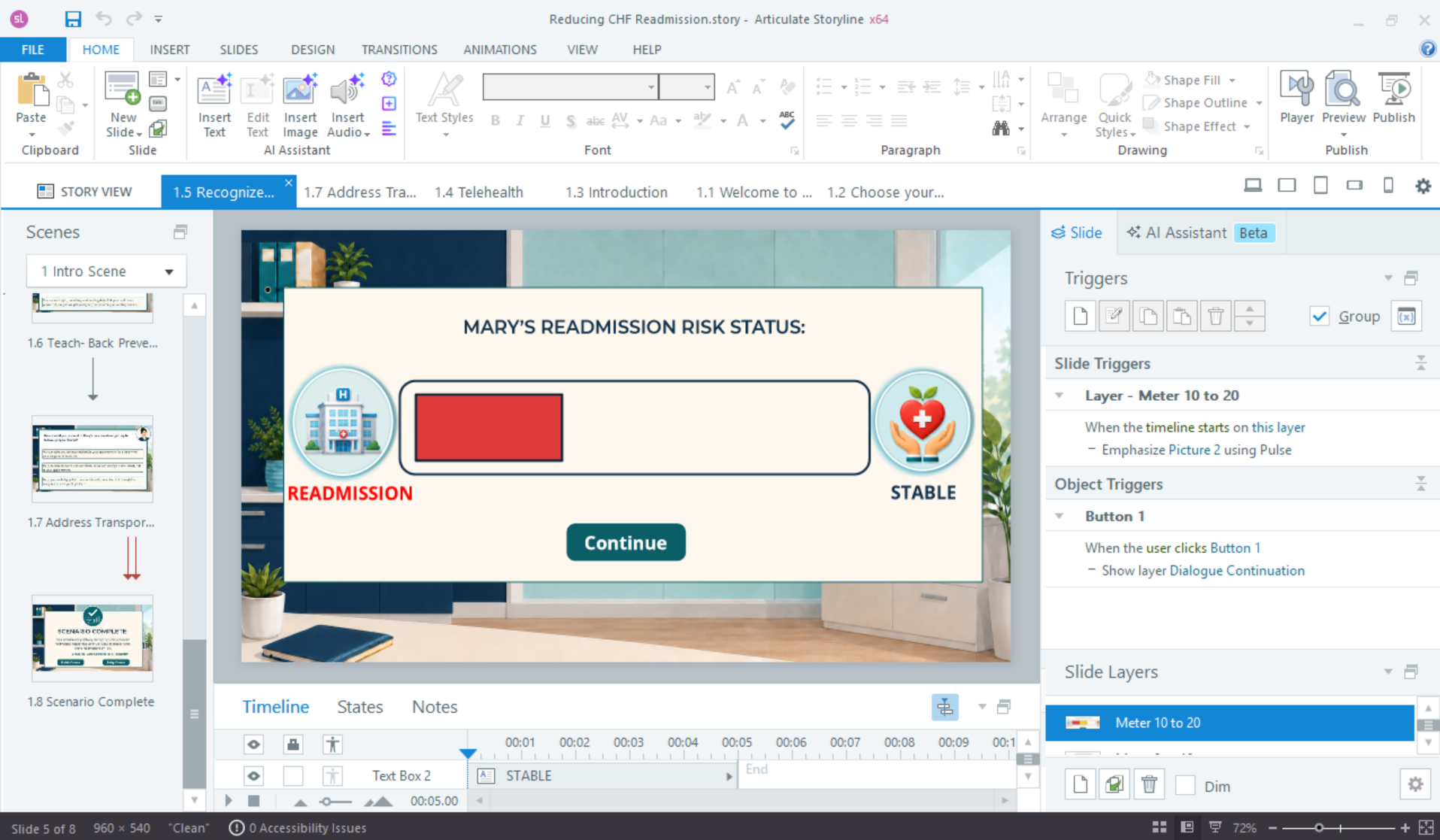
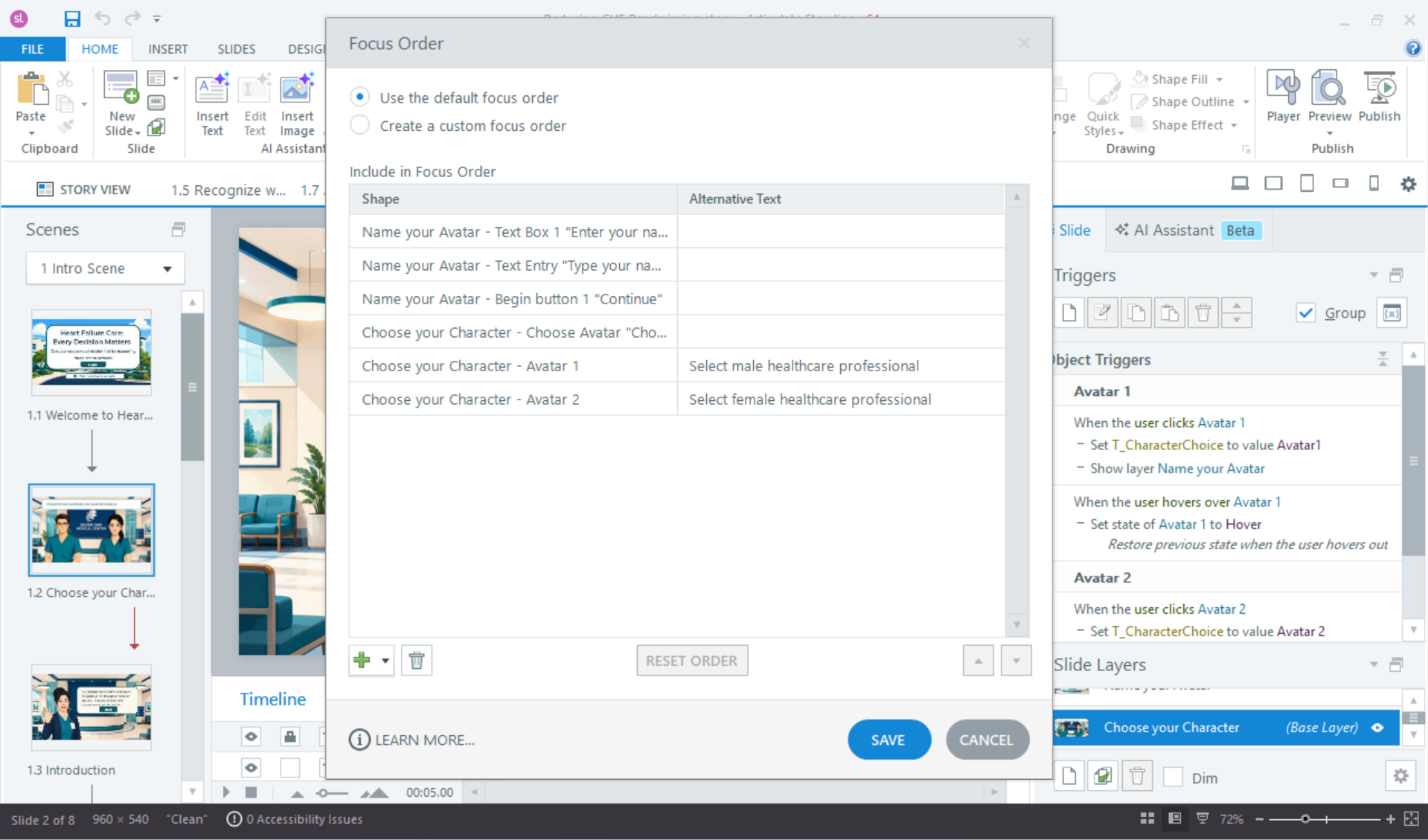
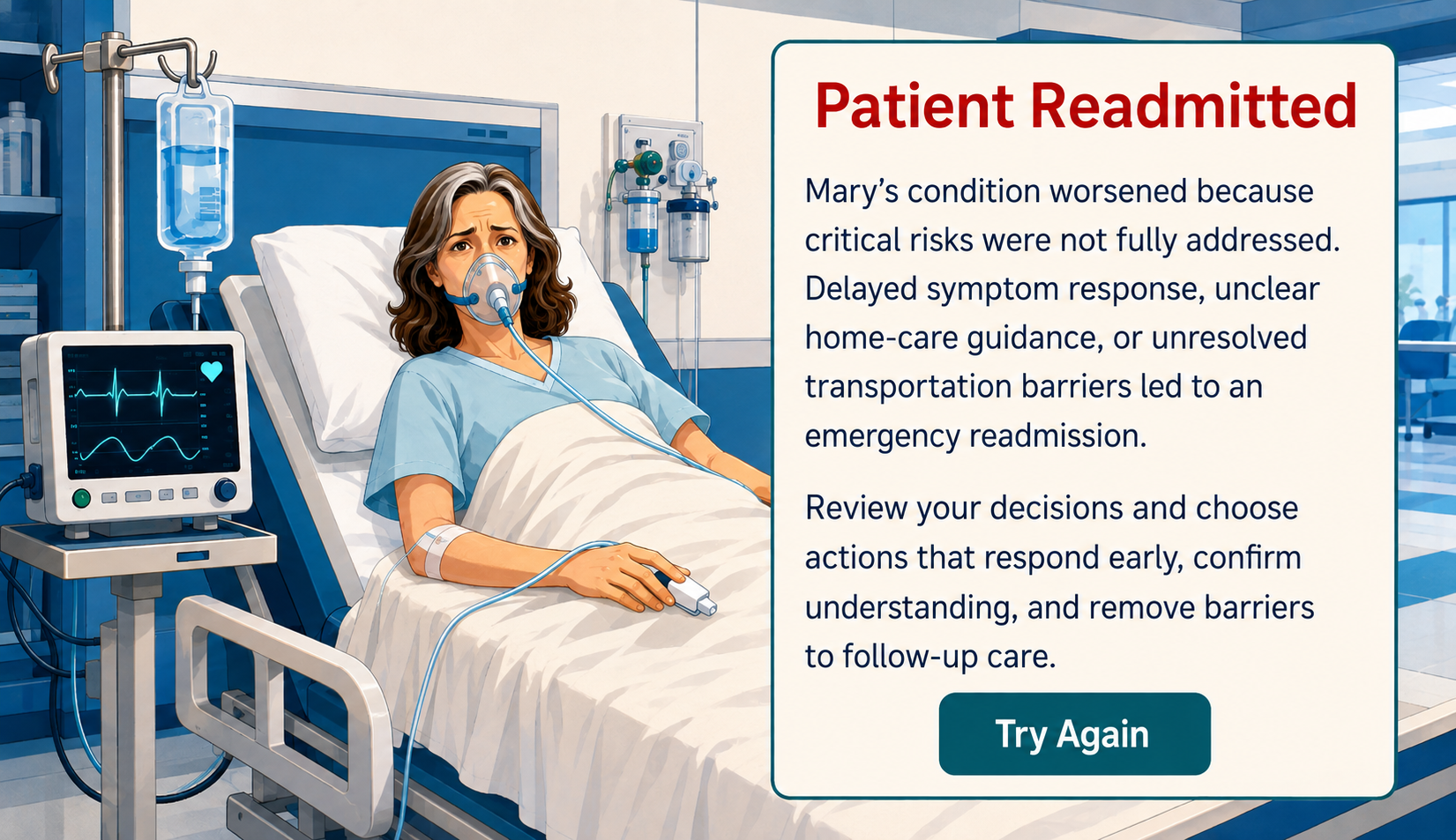
After confirming the prototype functioned as intended, I moved into full development in Articulate Storyline 360. I completed the entire experience: the introductory sequence, avatar selection, personalized name entry, mentor orientation, telehealth interaction, all three decision-making scenarios with consequence screens, the readmission-risk meter, and final outcomes.
Each decision includes realistic response options, immediate feedback, and meaningful consequences. The readmission-risk meter updates after every decision. Subtle animations, timed transitions, hover effects, and character changes maintain immersion throughout.
Accessibility was incorporated throughout development per WCAG guidelines: contrast ratio of at least 4.5:1 for essential text, minimum 44×44px click targets, keyboard-accessible controls, logical focus order, descriptive alternative text, and closed captions for all audio.
Completed Course Screens
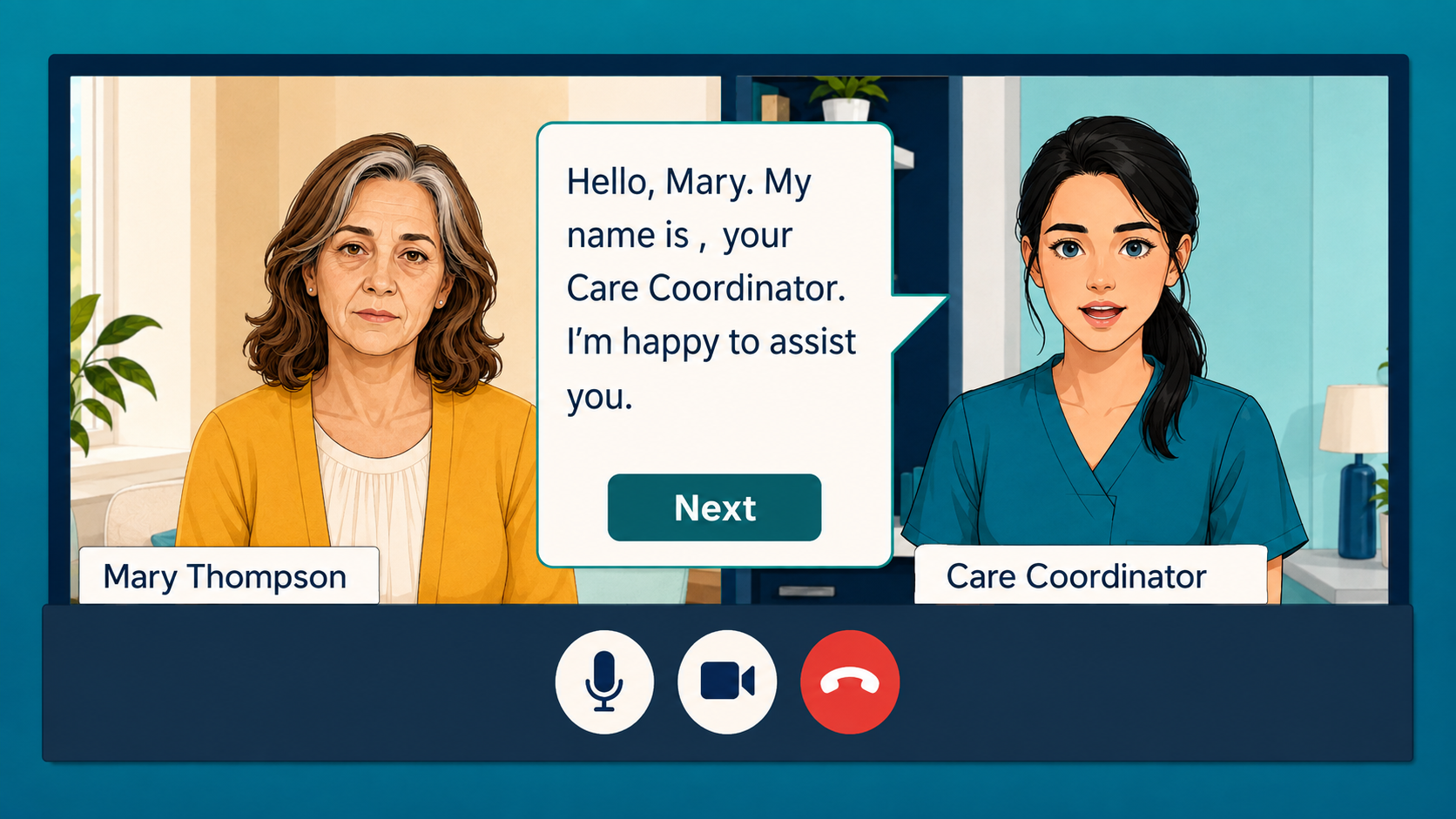
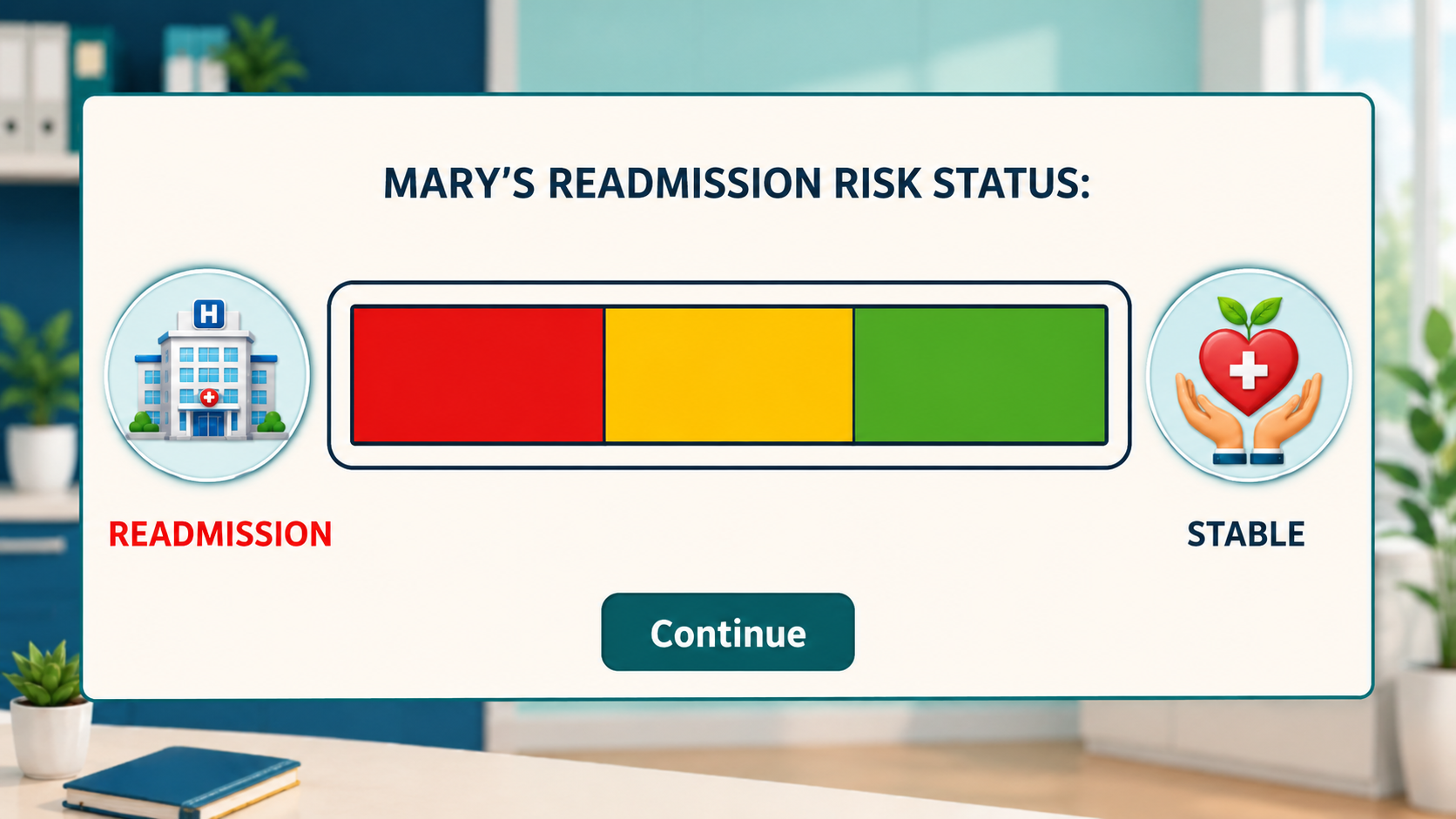
Since the course has not yet been implemented, the proposed process would begin with a pilot involving a small group of care coordinators. Clinical subject-matter experts and accessibility reviewers would examine the content, usability, accuracy, and learner experience before organization-wide deployment.
After revisions, the course would be published as a SCORM package and uploaded to the organization's LMS, then assigned to newly hired and existing care coordinators with clear completion instructions, a reasonable deadline, technical support, and automated reminders.
Since the course has not yet been delivered to actual learners, no performance or organizational outcomes are currently available. The proposed evaluation process would measure learner reactions through a post-course survey, learning through scenario performance and pre/post assessments, and workplace application through supervisor observations.
At 30-, 60-, and 90-day intervals, the organization could examine whether coordinators are identifying CHF warning signs, using teach-back, and addressing transportation needs more consistently. Thirty-day CHF readmission data could then be compared with the pre-training baseline to determine whether the course contributed to the targeted 15% reduction.
Because this course was developed as a portfolio project and has not yet been implemented in a clinical setting, no learner-performance or patient-outcome data are currently available. The proposed 15% reduction in 30-day CHF readmissions within six months remains a performance target rather than a confirmed result.
Key takeaways from the project:
More Projects
Additional learning experiences spanning gamification, microlearning, and AI-powered video production.

Articulate Storyline 360 · Gamification
Problem
Employees needed practical guidance recognizing ethical issues in everyday workplace situations — not just policy awareness. Traditional knowledge-based quizzes didn't give enough opportunity to observe a situation, identify concerns, and connect behavior to consequences.

Articulate Rise 360 · Microlearning
Problem
Beauty consultants at Glow & Co. struggled to consistently meet monthly KPIs. Many didn't know how to translate large targets into manageable daily goals, and inconsistent consultations affected conversion rates and overall sales performance.

Synthesia · Onboarding Video
Problem
As Gamified Learning Co. expanded, new employees lacked a consistent understanding of the values expected to guide their daily decisions — risking inconsistent output quality, overlooked accessibility needs, and weaker team collaboration.